


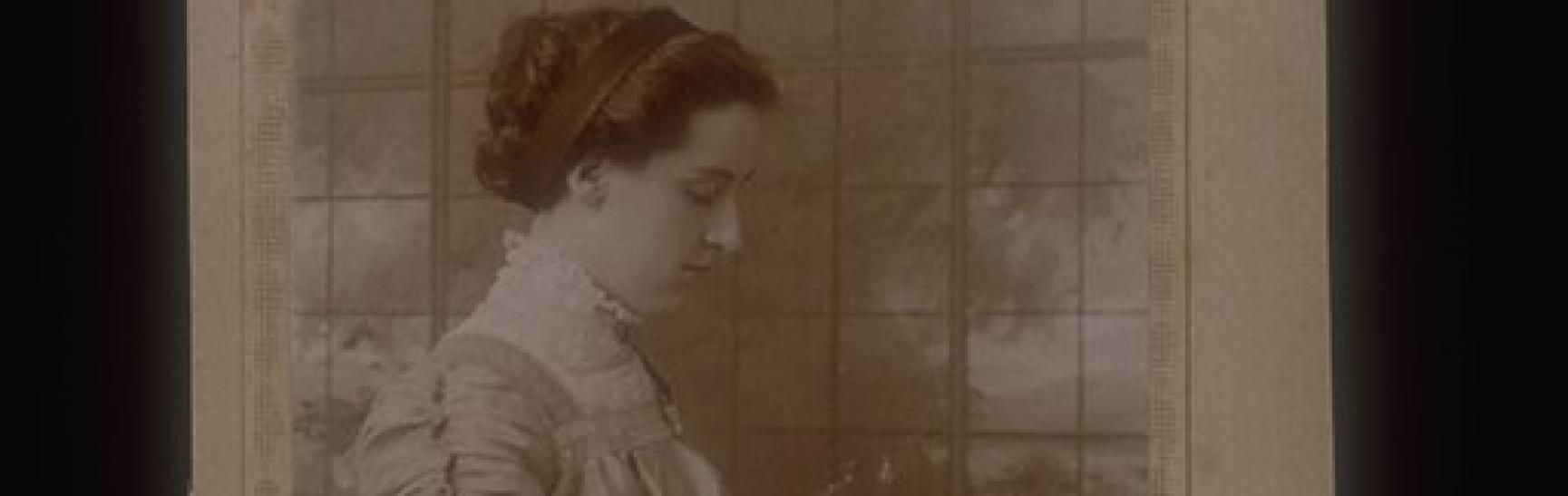
Selina Martin: A Shocking Struggle for Suffragism
On 8th March, International Women's Day, we celebrate Selina Martin, a true Tide Turner when it came to women’s fight for the right to vote in the UK.
The daughter of a Lancaster bookseller has only recently been acknowledged with a plaque unveiled in Sun Street where the family moved from their smaller home in Ullswater Road. Yet at the height of her struggles as a Suffragette, Selina was celebrated in the local press where she was hailed a hero. And the torture she endured while being force fed in prison helped to change attitudes towards the painful procedure.
Originally from Ulverston, Selina first joined the Women’s Social and Political Union as a 25-year-old in 1908, the same year that the Prime Minister, Herbert Asquith, attended a political meeting at the Drill Hall in Dallas Road. Their paths were to cross just a year later when, together with another Suffragette, she asked the Prime Minister about his views on women’s suffrage as he was leaving his car. When he ignored them, Selina threw an empty ginger beer bottle into his vehicle and both were arrested and taken to Walton Prison. There the pair went on hunger strike and were treated so badly that Selina complained to visiting magistrates who ignored her protest.
However, the case did come to the attention of Lady Constance Lytton, also a Suffragette, who had been released from a prison after only two days without being force fed, just two months before Selina’s imprisonment. She was so concerned about how Suffragettes of different classes were treated that when next arrested she gave a false name and wore a disguise, only to be treated as badly as Selina, so raising more awareness of the barbaric measures which most working class Suffragettes were suffering.
But the Walton experience wasn’t the first time that Selina had gone on hunger strike while imprisoned. Just a couple of months before, she was jailed in Birmingham after assaulting a police officer and a member of the public during a protest. In prison, she complained about the poor ventilation by using her shoe to smash up everything in reach. After escaping handcuffs twice, another pair were used which led to her becoming unconscious. Later, she went on hunger strike and after three days was force fed by two untrained doctors who she described as tearing at her jaw and half-suffocating her. On being released from jail a few weeks later, she was thin and weak.
Despite the cruelty Selina suffered as a Suffragette, she lived until she was 90 in Lancaster where she married and brought up her family. She died in 1972 and is buried in Lancaster Cemetery.
Her story is told at Lancaster City Museum which also has a medal and brooch in its collections which belonged to Suffragette sisters, Hilda and Lillian Burkitt (later known as Ida Cunard), who retired to Morecambe. Hilda is said to be the first Suffragette to be force fed which she endured 292 times, more than any other Suffragette. She had joined the Women’s Social and Political Union in 1907 in Birmingham and two years later was arrested four times for her actions which included throwing a stone at a train transporting Prime Minister Asquith.
Hilda’s sister, Lillian, was arrested once in 1908 and spent time in Holloway prison after being part of a group who tried to force their way into Parliament in their campaign for the vote. She later became a nurse in World War One where she served at Gallipolli.
On retirement in Morecambe, Hilda, who married, continued to organise the North West branch of the Suffragette movement. She died in 1955, aged 78 followed by Lillian in 1962, aged 90.
Another local woman who played her part in campaigning for the female vote was Annie Helme who helped set up Lancaster Suffrage Society in 1911 and became its secretary. The sister-in-law of Lancaster MP, Norval Helme, Annie later became Lancaster’s first woman councillor. At a ceremony in Lancaster Town Hall, she also became its first female mayor in 1932. Since then, Lancaster has had 31 women mayors. Annie was the first woman chair of the Local Education Committee too and the first female magistrate for the South Lonsdale Division. She died in 1963 and is buried in Lancaster Cemetery.
All women over 21 were finally given the vote in 1928 but it took more than 40 years before Lancaster elected its first female MP, Elaine Kellett-Bowman who served until 1997, the year when Geraldine Smith became Morecambe’s first woman MP. Now the district has two female MPs, Cat Smith for Lancaster and Wyre, and Lizzie Collinge for Morecambe and Lunesdale. Lancaster City Council is also led by a woman, Councillor Caroline Jackson.
Find out more about: International Women's Day 2026
Find out more about Hilda and Lillian Burkitt: My Museum Passion - the memory of Morecambe's suffragettes
Visit: Lancaster City Museum